Couples Budget Spreadsheet
Fair Bill Split by Income · Shared Expense Tracker
View on Etsy- Excel + Google Sheets
- Instant download
Split your shared bills in a way that feels fair to both of you – see four ways side by side and what each of you keeps – then log who paid what and always know who owes whom.
For couples in the US who live together – dating, engaged or married – with two incomes (or one). Enter your take-home pay and your regular bills once, pick how you split, and the sheet works out each person's monthly share, settles up your shared spending and compares each month with your plan.
WHAT IT ANSWERS
- How much should each of us put in each month – 50/50, by income, or so we both keep the same amount?
- What does each of us have left for ourselves after the bills?
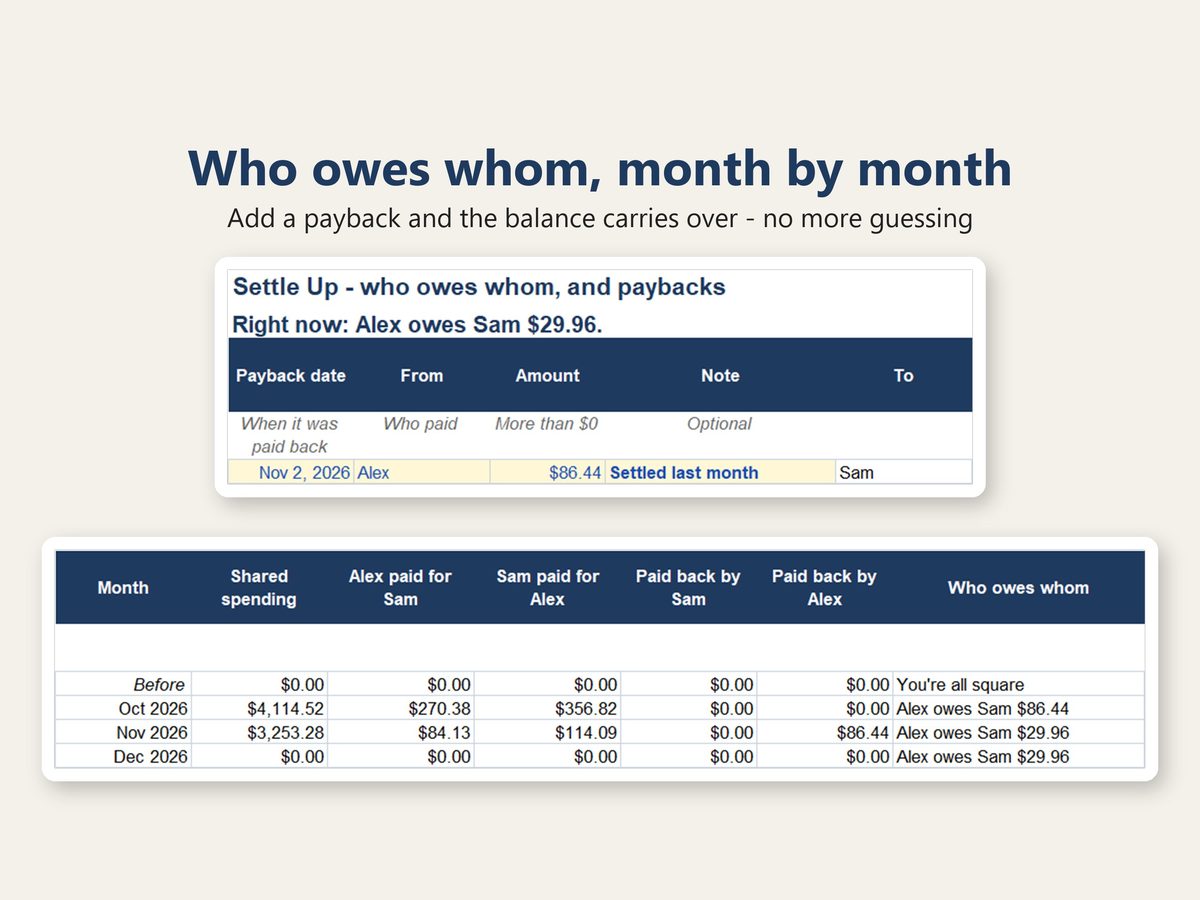
- Who owes whom right now for groceries, dinners and the other things one of us paid for?
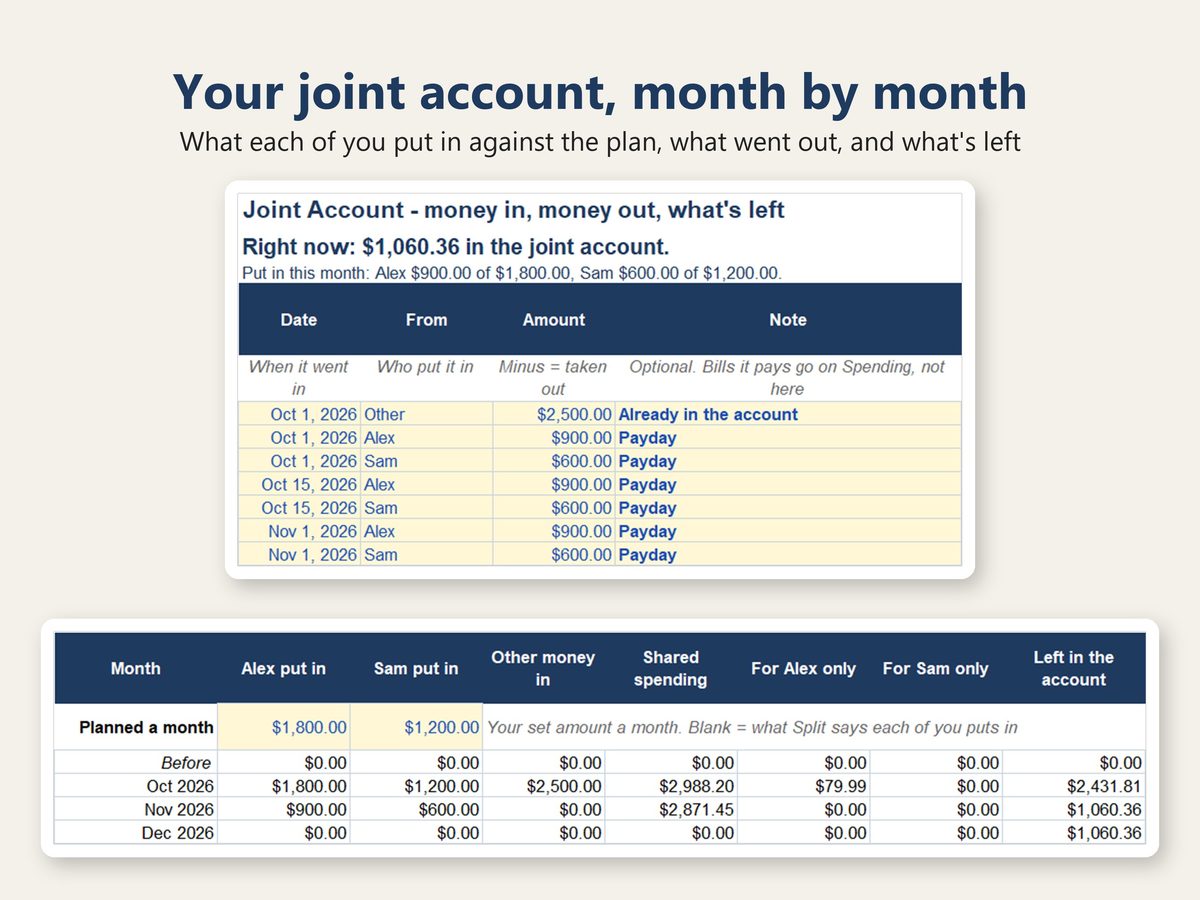
- Is our joint account keeping up – what each of us put in, what went out, and what's left?
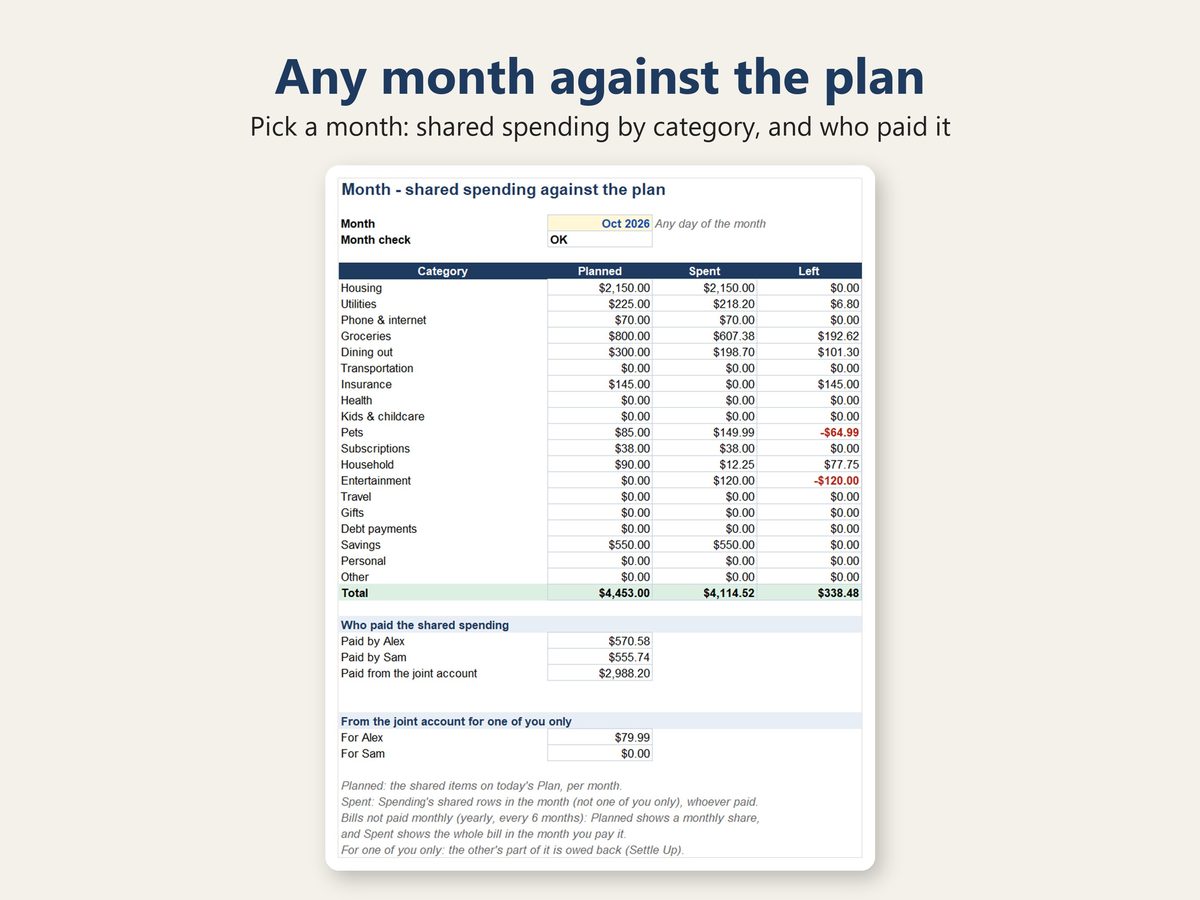
- Are we sticking to our plan this month, category by category?
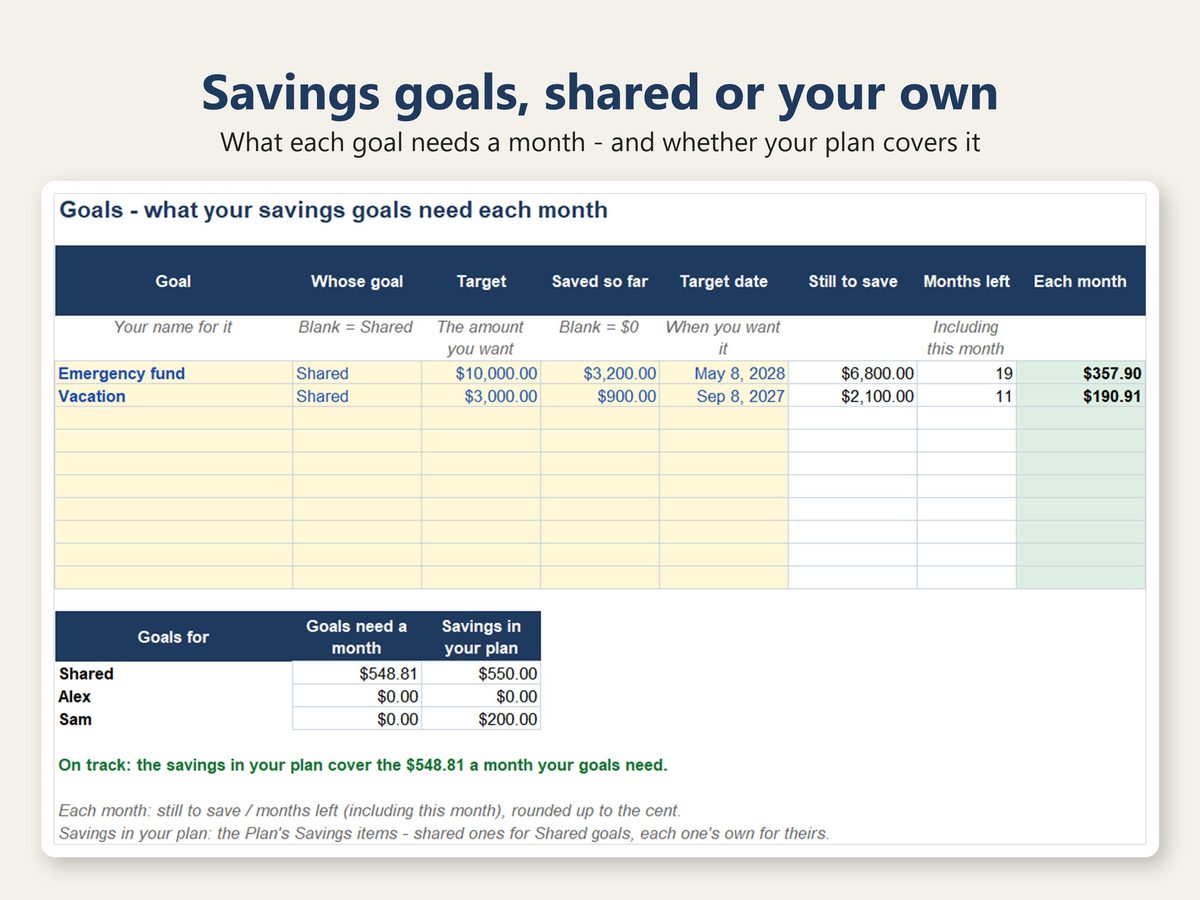
- How much do our savings goals need each month – and does our plan cover it?
HOW IT WORKS
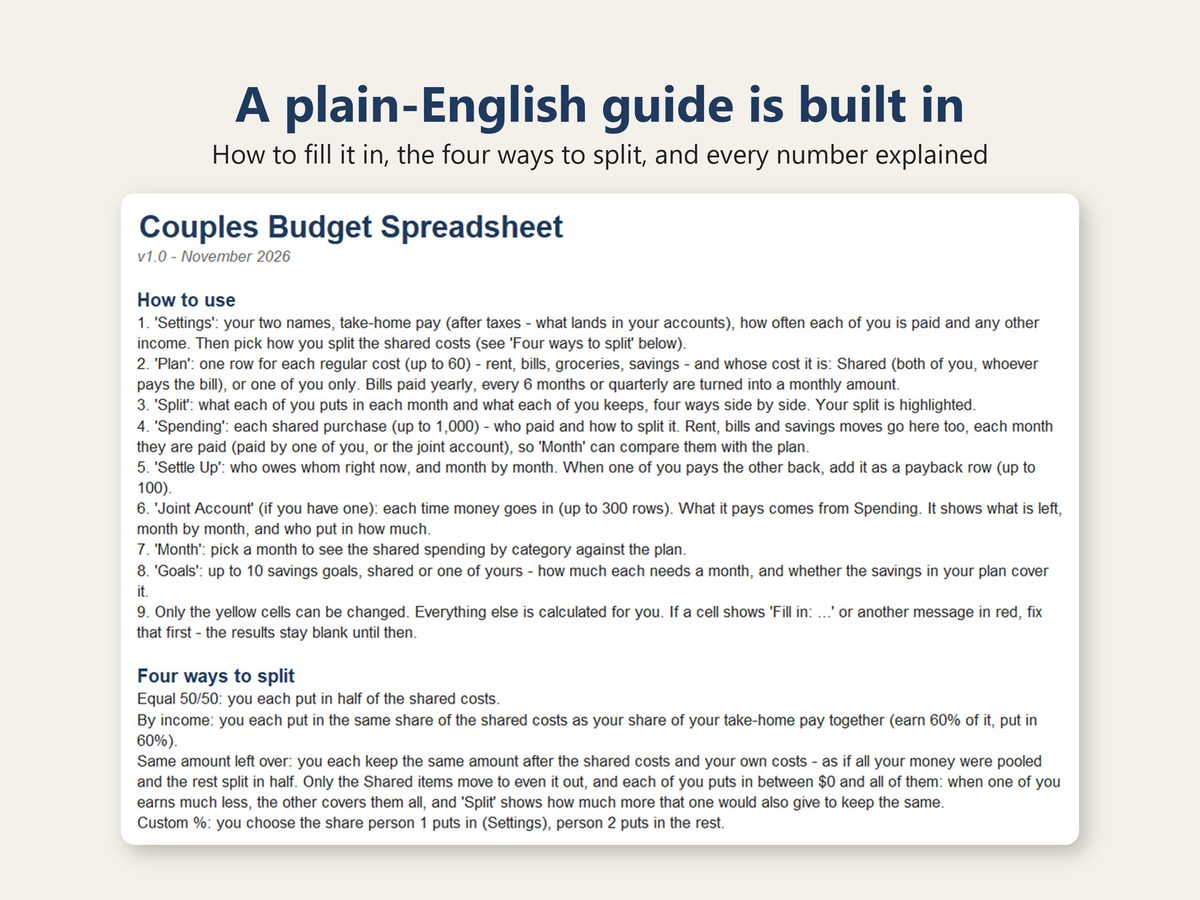
- Settings: your two names, take-home pay and how often each of you is paid (monthly, twice a month, every 2 weeks, weekly or yearly), any other income a month (a side job, overtime, tips), and how you split the shared costs: Equal 50/50, By income, Same amount left over, or your own %.
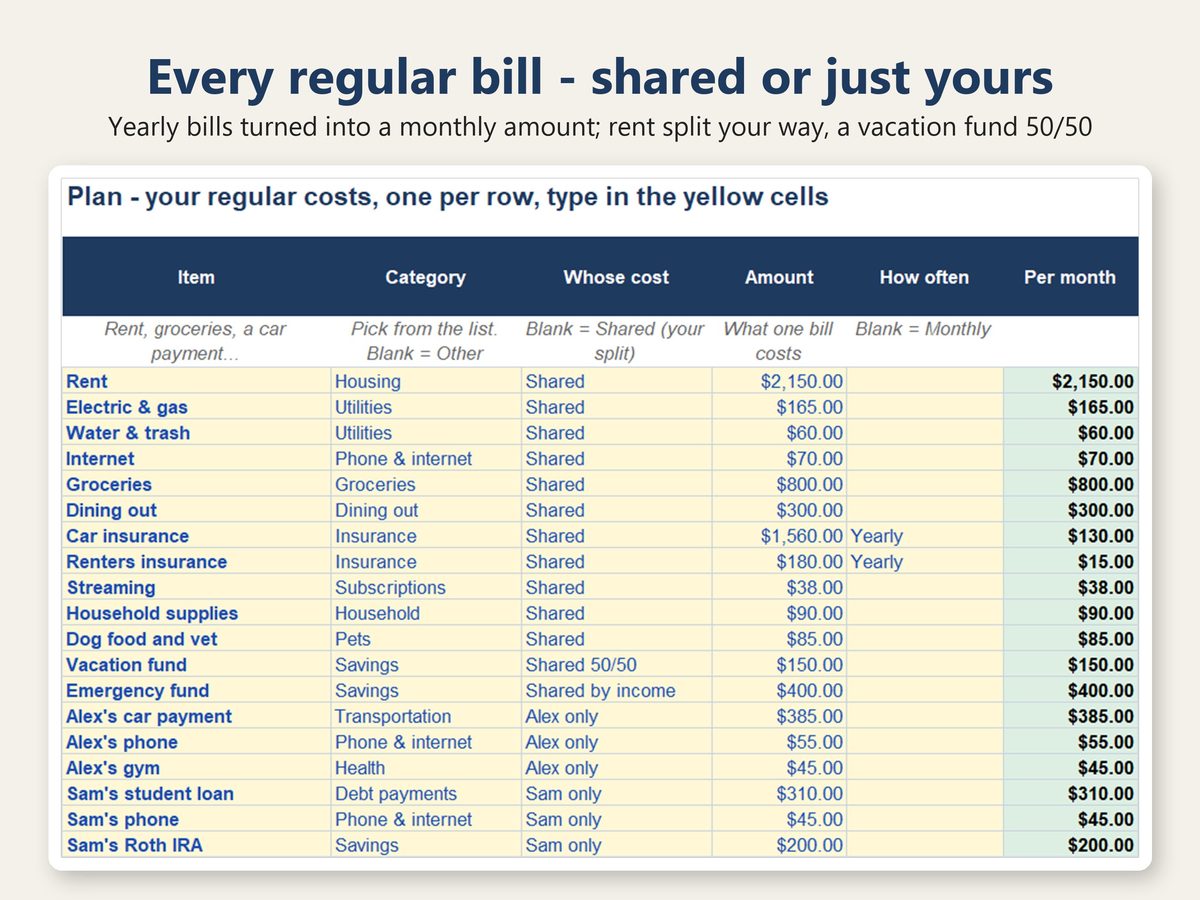
- Plan: each regular cost (up to 60) – rent, utilities, groceries, insurance, savings – and whose cost it is: shared (whoever pays the bill), or one of you only. Bills paid yearly, every 6 months or quarterly become a monthly amount. Some items can always be split 50/50 or by income, whatever split you picked.
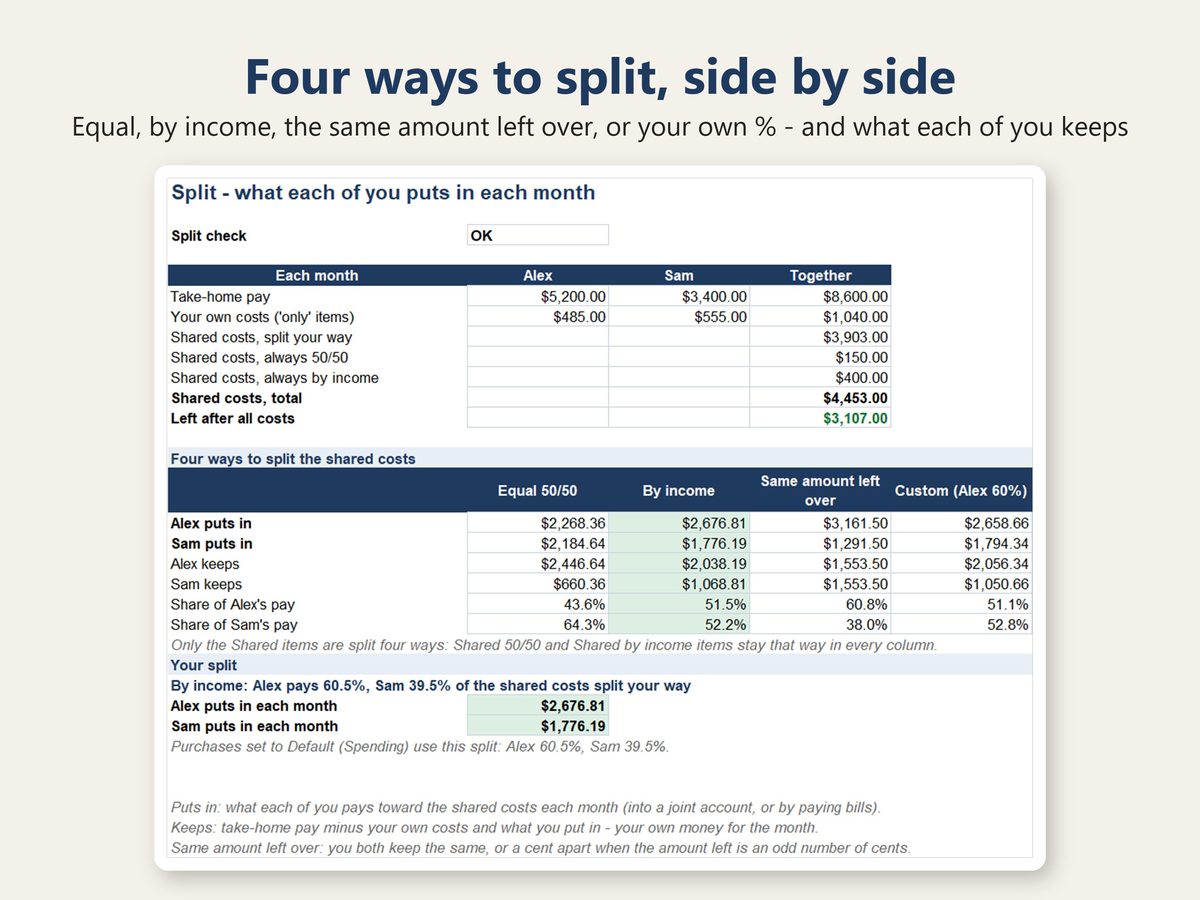
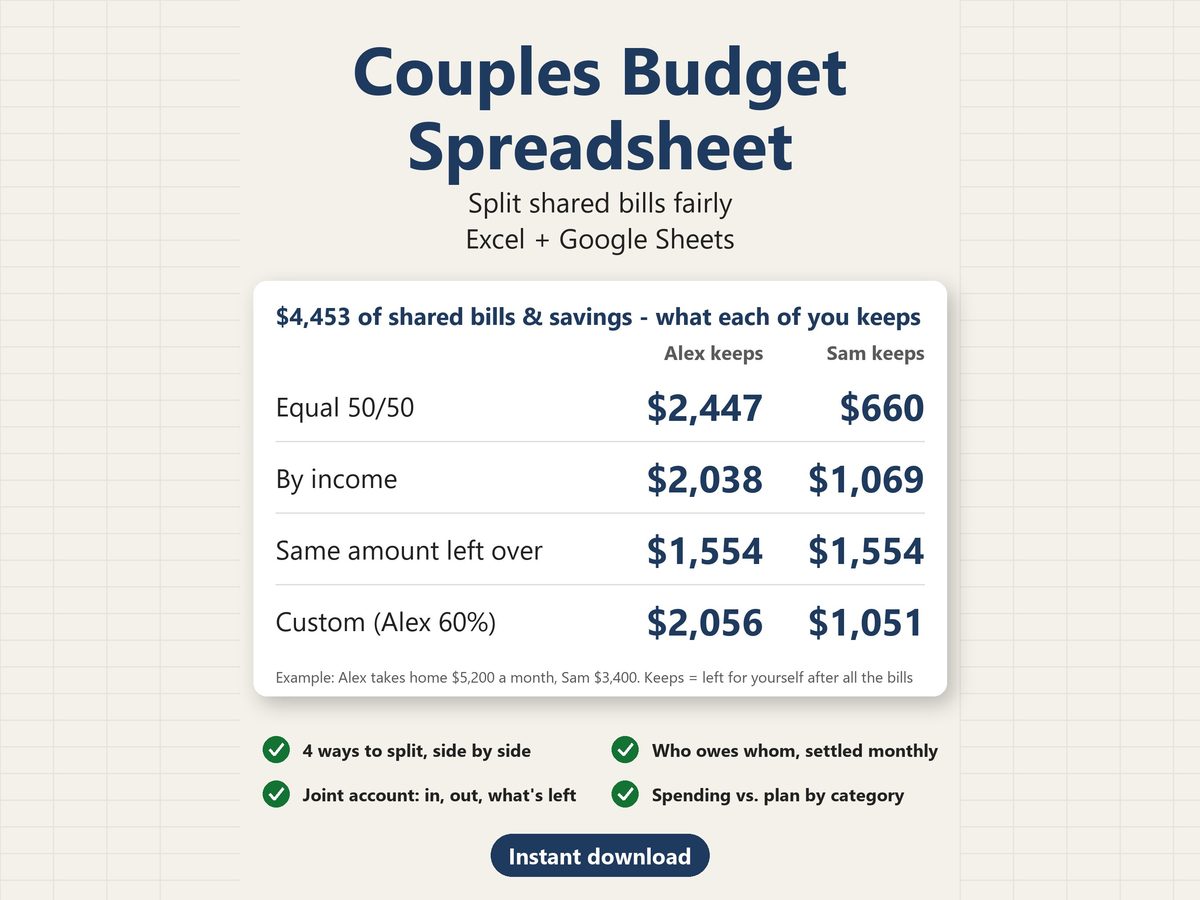
- Split: the four ways side by side – what each of you puts in, what each of you keeps, and the share of each paycheck that goes to shared costs. Your split is highlighted.
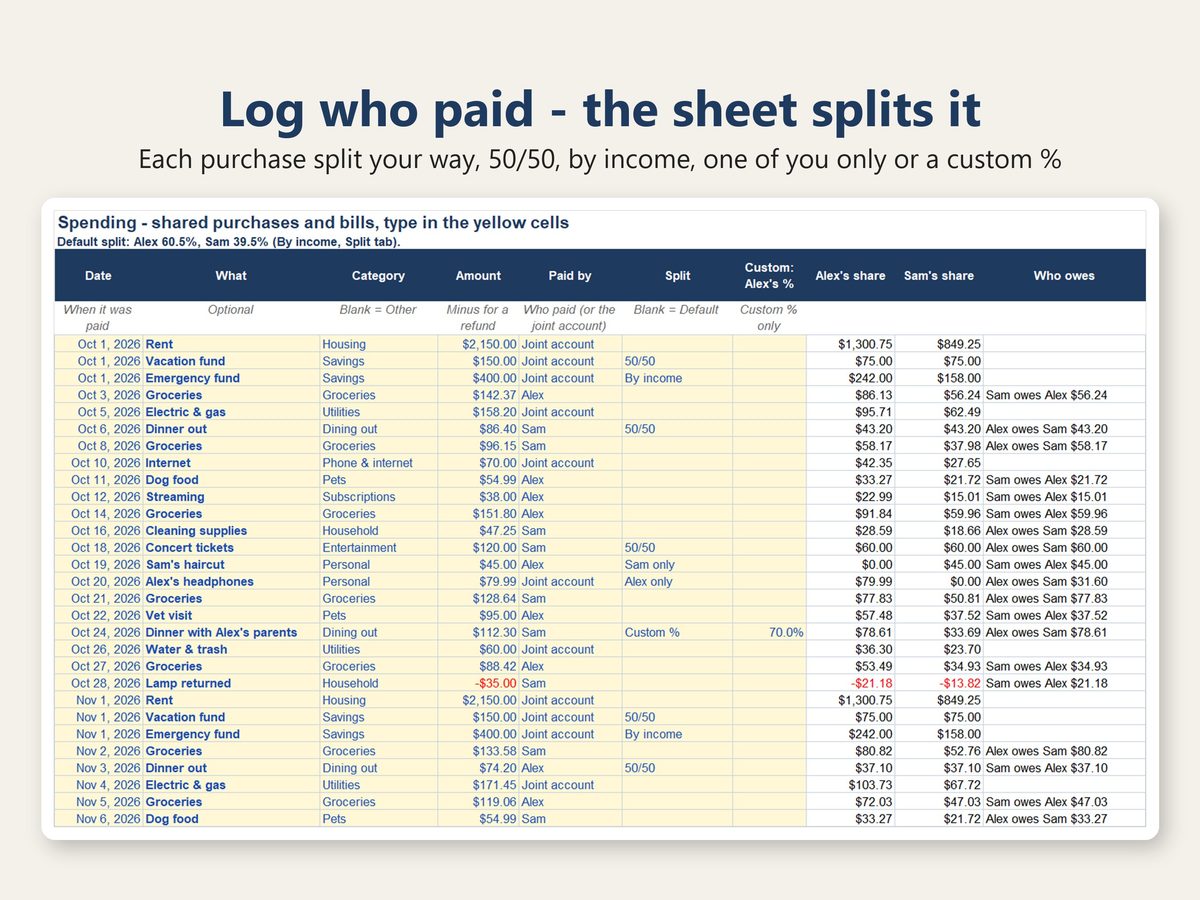
- Spending: each shared purchase (up to 1,000) – who paid (one of you or the joint account) and how to split it: your default split, 50/50, by income, one of you only, or a custom %. Refunds too (enter them as a minus amount). Rent and bills go here too, each month they're paid – by either of you or from the joint account.
- Settle Up: who owes whom right now, plus a month-by-month table. Add a payback when one of you pays the other, and the balance carries over.
- Joint Account: each time money goes in (up to 300) – from either of you, or what was already in it. What it pays comes straight from Spending, so you see month by month what each of you put in against your plan, what went out (shared, or for just one of you) and what's left.
- Month: pick a month to see shared spending by category against the plan, and who paid it.
- Goals: up to 10 savings goals, shared or one of yours – what each needs a month, and whether the savings in your plan cover it.
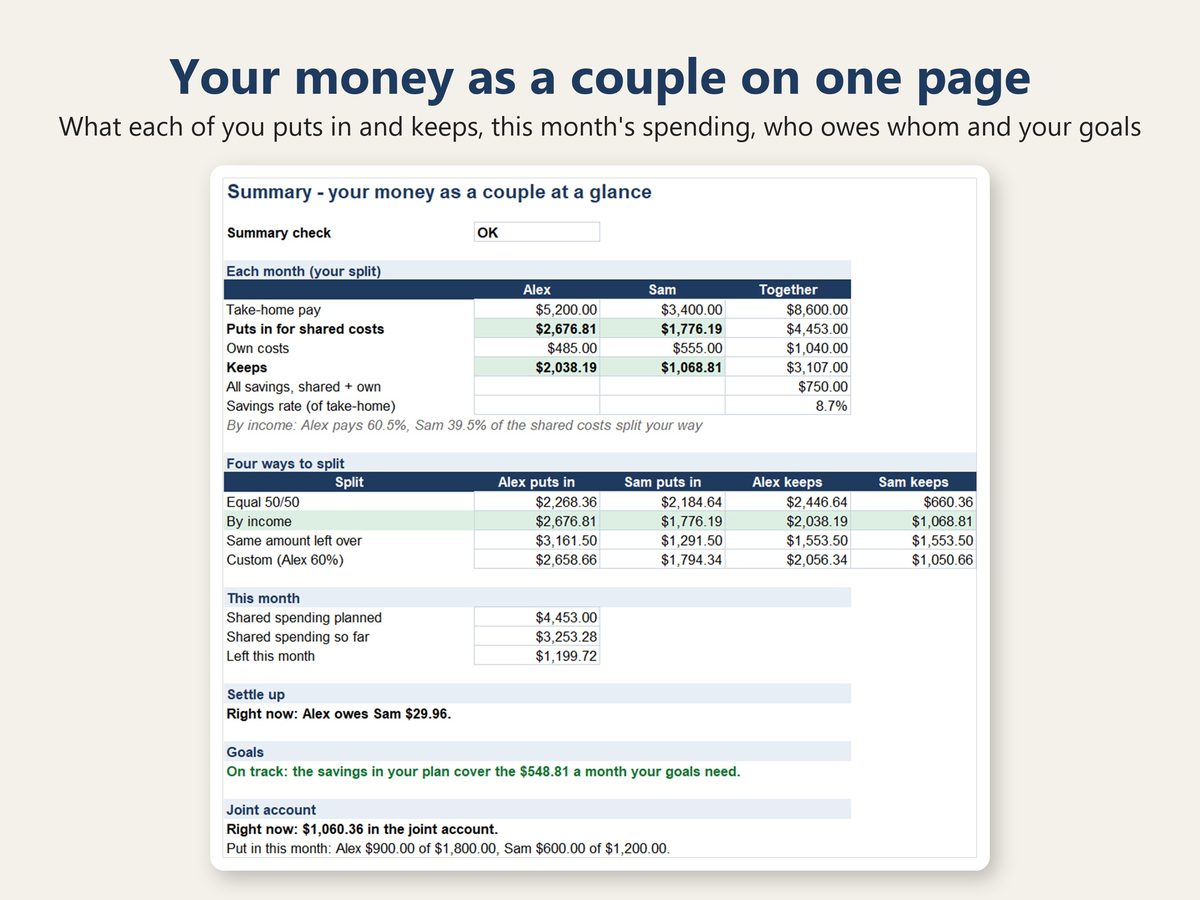
- Summary: the whole picture on one page.
EXAMPLE IN THE PHOTOS
Alex and Sam take home $8,600 a month together and share $4,453 of bills and savings. Split 50/50, Sam keeps just $660.36 after the bills; by income, Alex puts in $2,676.81 and Sam $1,776.19; with the same amount left over, they each keep $1,553.50. Last month is settled, and this month Alex owes Sam $29.96. The joint account pays their rent, bills and savings (groceries go on their own cards and get settled up), so they each move a set amount into it on payday – less than their full share – and it holds $1,060.36 right now.
WHAT YOU GET
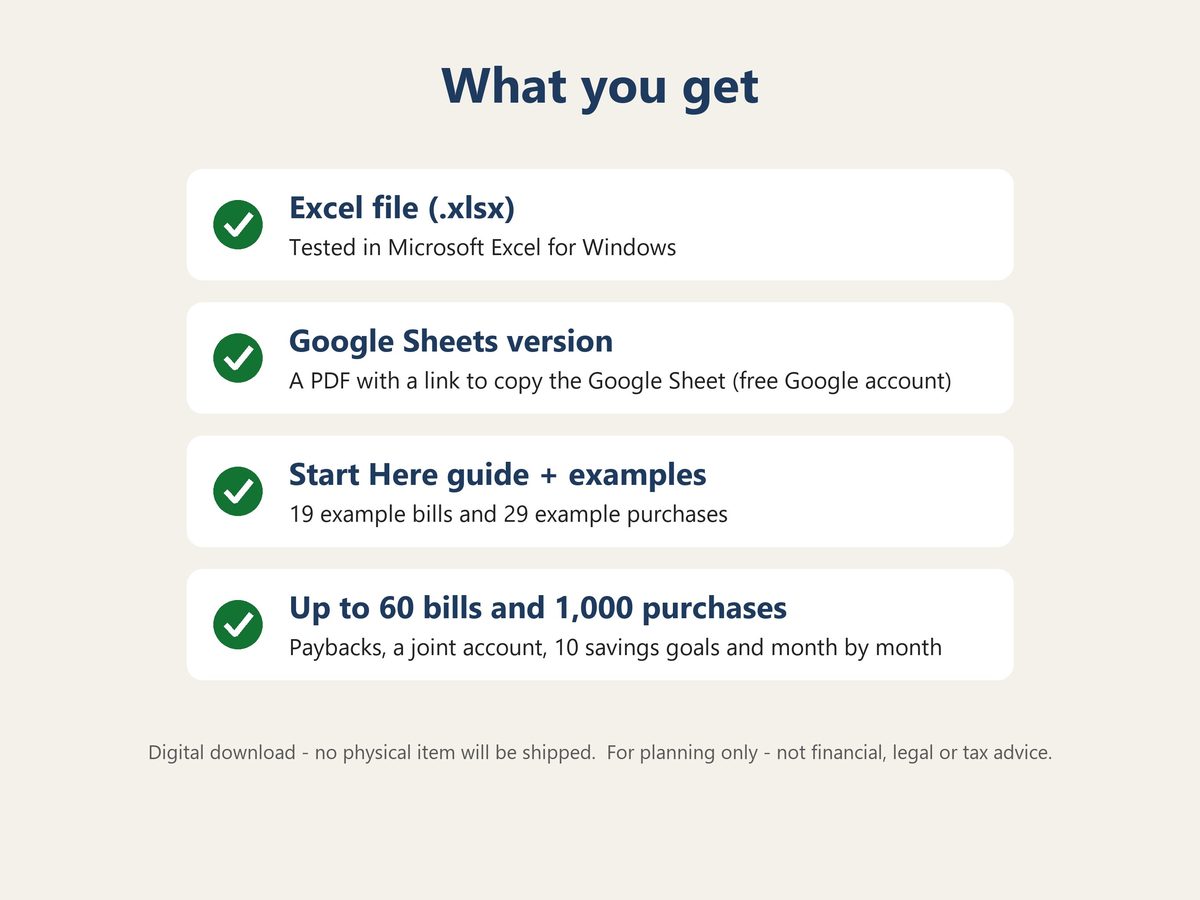
- Excel file (.xlsx) for Microsoft Excel (tested on Windows)
- Google Sheets version: a PDF with a link to make your own copy – for a Mac or Chromebook, or if you do not have Excel
- Start Here tab: step-by-step instructions and the meaning of every number (see photo 10)
- 19 example bills, 29 example purchases and 7 example deposits – replace them with your own
- Made for a computer screen: the sheets are wide, and it has not been tested on a tablet or phone.
GOOD TO KNOW
- There is no one right way to split: the four columns show what each choice means for both of you, so you can decide together.
- Take-home pay means after taxes and deductions – what lands in your accounts. Self-employed? Use what's left after setting tax aside. Pay that changes (overtime, freelance work)? Use a typical amount, like the average of the last few months.
- Joint account purchases don't change who owes whom – except something for just one of you: part of that money was your partner's (at your usual split), so that part is owed back.
- Got a raise or changed how you split? Add one line to Split history (Settings) first, and the months you have already settled keep their split.
- Amounts are in US dollars.
- Only the yellow cells can be changed, so the formulas are hard to break by accident. No macros or add-ons – just formulas.
- No joint account? Log the rent and each bill in Spending when it's paid, by whoever paid it – Settle Up works out who owes whom (copy last month's bill rows to save typing). Leave the Joint Account tab empty.
- Both of you can log purchases in one copy: share it in Google Sheets, or save it to OneDrive and share it in Excel.
- Room for 60 regular costs, 1,000 purchases, 100 paybacks, 300 deposits, 10 goals and 24 months.
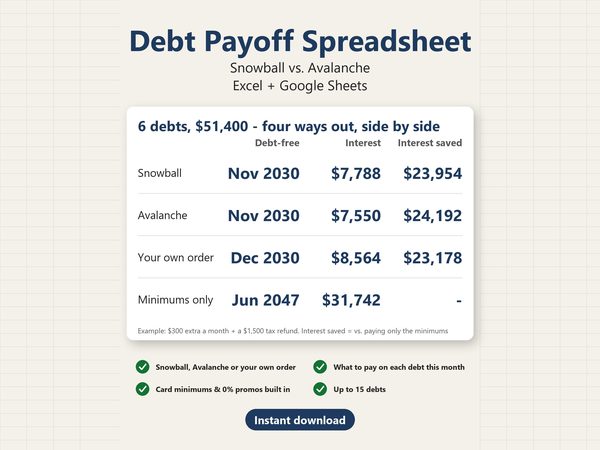
- Paying off debt together? Our Debt Payoff Spreadsheet works out the snowball and avalanche plans.
- This is a digital download. Nothing will be shipped.
- A calculator for planning only. This is not financial, legal or tax advice.
- For your personal use. Please do not resell or share the file.
ABOUT THIS TEMPLATE
Designed by SlateTally with the help of AI tools. Every result was checked in Microsoft Excel against an independent calculation, including unusual inputs such as one partner with no income, income from a side job alone, both incomes at zero, a 0% and a 100% custom split, the same-amount-left-over split capped at $0 or at all of the shared bills, costs above take-home pay, a savings goal for just one of you, a refund, a purchase for one of you paid from the joint account, a purchase dated before or after the months shown or later than today, a payback larger than the balance, a change of pay or split after a month was settled, money taken back out of the joint account, a joint account running below zero, and 1,000 purchases.
Questions? Send a message – happy to help.